
Guest Post • January 26, 2026

How Small Business Owners Can Manage Sudden Rapid Growth Successfully

Small business owners who experience sudden growth face a paradox: the success they worked for can quickly become the problem they didn't plan for. Orders double, but systems break. New customers arrive, but quality slips. What felt manageable last month now demands decisions about hiring, operations, and cash flow that can't wait. The difference between businesses that scale successfully and those that stumble isn't luck, it's understanding which fundamentals to strengthen first.


Quick Summary: Managing Your Growth Successfully

  • Build scalable processes and systems early to handle increased demand without overwhelming your team.
  • Forecast your finances carefully to anticipate cash flow needs during rapid expansion phases.
  • Hire strategically by focusing on roles that directly support growth and align with your vision.
  • Optimize your supply chain to prevent bottlenecks that could slow down customer fulfillment.
  • Invest in targeted marketing that sustains momentum while attracting customers who fit your brand.


How to Assess Your Business Infrastructure for Growth

Here's how to move from plan to action.


Before scaling operations or launching new ventures, you need a clear picture of what your business can handle right now and where you'll need support. This process helps small business owners manage sudden rapid growth successfully by identifying gaps early and connecting with expert resources when needed.


Step 1: Map Your Current Team Capacity

Start by reviewing how your team spends their time each week. To evaluate capacity, assess your employees' workloads and their availability, then compare that data to upcoming project scopes, budgets, and deadlines. This snapshot reveals whether you can absorb new demand or need to hire before committing to expansion.


Step 2: Identify Your Legal and Compliance Baseline
Review what licenses, permits, and registrations your business currently holds and what documentation you maintain. As you grow, you'll need to document critical compliance-related data systematically so audits and renewals don't catch you off guard. If you're launching a new venture or restructuring, explore formation services that handle state filings and compliance tracking for you, such as those offered by 
ZenBusiness.


Step 3: Audit Your Technology and Process Tools

List the software, platforms, and workflows your team relies on daily, then ask whether each one can scale with increased volume. With 60 percent of small businesses now using AI capabilities for content creation, social media management, and customer service, consider where automation could free up your team's time. Choose tools that integrate smoothly and reduce manual handoffs.


Step 4: Calculate Your Financial Runway for Growth Investments

Estimate the cash you'll need to cover hiring, inventory, marketing, and compliance costs over the next six months. Compare that figure to your current reserves and projected revenue to identify any funding gaps. Knowing your runway early lets you explore financing options or adjust your growth timeline before cash flow becomes a crisis.


Step 5: Connect with Expert Support for Complex Tasks

Identify tasks that require specialized knowledge, such as legal formation, tax planning, or regulatory compliance, and research service providers who can handle them efficiently. Outsourcing these areas to experts frees you to focus on customers and operations while ensuring nothing falls through the cracks. Many platforms now bundle formation, compliance, and advisory services to simplify setup for new ventures.


With these steps complete, you'll have a clear foundation for building the systems that sustain momentum.


Your Growth Management Rhythm

To keep momentum without losing control, establish a repeating cycle. This workflow transforms the steps you've just completed into a sustainable rhythm that adapts as your business evolves. By revisiting key stages on a regular schedule, you ensure your operations stay aligned with demand while keeping your team focused and your systems ready for what's next.
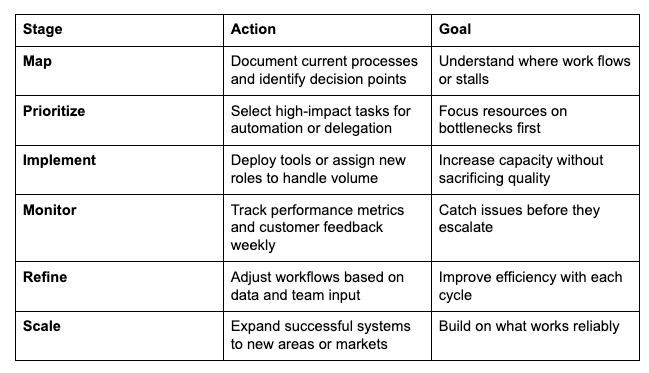


Each stage feeds the next, creating a loop that turns reactive firefighting into proactive management. When you monitor results and refine your approach regularly, you build confidence in your systems and free up mental space to focus on strategy rather than survival. With roughly 60% of companies using automation solutions tools in their workflows, adopting this rhythm positions you to compete effectively while maintaining the flexibility small businesses need.


Start with one cycle and watch your operations stabilize as growth accelerates.


Your Rapid Growth Action Checklist

Here's your implementation roadmap:


Managing sudden rapid growth successfully requires clarity on what to do first and what to track daily. This checklist distills the essential actions small business owners need to protect quality, sustain momentum, and build capacity as demand surges.


 Document your current workflows and identify bottlenecks slowing delivery

 Streamline inventory management to prevent stockouts and reduce waste

 Establish a weekly KPI sheet for marketing ROI tracking

 Assign high-impact tasks to automation tools or new team members

 Review supplier contracts and lead times to strengthen your supply chain

 Invest in scalable technology that grows with your customer base

 Schedule weekly check-ins to monitor performance metrics and customer feedback

 Refine processes based on data insights and team input each month


With these actions in place, you'll transform growth pressure into sustainable progress.


Leading Your Business Through Rapid Growth with Confidence and Clarity

Rapid growth can feel overwhelming when systems strain and decisions pile up faster than answers arrive. The business owners who navigate this phase successfully are those who build strong foundations first, hiring strategically, streamlining operations, and investing in scalable systems before the pressure peaks. Growth doesn't have to mean chaos if the right structures are in place. Take one action from your checklist this week, whether that's documenting a key process or scheduling a conversation with your team about capacity. That single step builds the confidence and momentum needed to scale without sacrificing the stability that got you here.


Website enhancements
By Marcus Lansky June 18, 2024
Website enhancements for small businesses
Thriving with Franchises: A Balanced Guide to Your Business Venture
By Marcus Lansky Guest Post June 6, 2024
Thriving with Franchises: A Balanced Guide to Your Business Venture
By Ryan Newton July 24, 2022
When it comes to SEO, there isn't a magic formula to instantly send your site off to the #1 search result on Google. But there are some basic principles you should follow for a wonderful starting point. Here are the top 5 SEO practices to start with: #1 Write for people, not for search engines Always write original, interesting, high quality site content that's error free and relevant to your site. Search engines like Google can easily detect content that is duplicated from elsewhere online, that contains grammatical errors, or that is stuffed with keywords. #2 Add a blog to your site and use rich media To engage your site visitors and blog readers, create posts that include non-textual media like photos, videos, or original visualizations (infographics). Having that extra content (especially if it's captivating) will increase the time users spend on your site as well as the likelihood they will share your site with their own community. #3 Offer a positive user experience throughout your site Google will know if you're using your site to aggressively advertise your service, or if you're being too pushy. Always aim to offer site visitors a pleasant experience on your site. That means clear content, support when needed, and always an option to go back. #4 Create a network of internal links (but don't overdo it) Add links between different pages of your site and your blog, but try to follow a process that feels organic rather than heavy linking meant just for search engine crawlers. Link between pages that make sense, for example, on your services page, link a certain industry specific term, and link it to a blog post you wrote about it, that gives more information on that term. #5 Always check your site's Core Web Vitals Core Web Vitals are a standard site performance standard initially created by Google. The report shows site owners how their site pages perform 'for real,' how long it takes for site visitors to load site pages, and it offers ways to fix issues, if there are any.
By Ryan Newton June 29, 2022
When it comes to SEO, there isn't a magic formula to instantly send your site off to the #1 search result on Google. But there are some basic principles you should follow for a wonderful starting point. Here are the top 5 SEO practices to start with: #1 Write for people, not for search engines Always write original, interesting, high quality site content that's error free and relevant to your site. Search engines like Google can easily detect content that is duplicated from elsewhere online, that contains grammatical errors, or that is stuffed with keywords. #2 Add a blog to your site and use rich media To engage your site visitors and blog readers, create posts that include non-textual media like photos, videos, or original visualizations (infographics). Having that extra content (especially if it's captivating) will increase the time users spend on your site as well as the likelihood they will share your site with their own community. #3 Offer a positive user experience throughout your site Google will know if you're using your site to aggressively advertise your service, or if you're being too pushy. Always aim to offer site visitors a pleasant experience on your site. That means clear content, support when needed, and always an option to go back. #4 Create a network of internal links (but don't overdo it) Add links between different pages of your site and your blog, but try to follow a process that feels organic rather than heavy linking meant just for search engine crawlers. Link between pages that make sense, for example, on your services page, link a certain industry specific term, and link it to a blog post you wrote about it, that gives more information on that term. #5 Always check your site's Core Web Vitals Core Web Vitals are a standard site performance standard initially created by Google. The report shows site owners how their site pages perform 'for real,' how long it takes for site visitors to load site pages, and it offers ways to fix issues, if there are any.
By Ryan Newton June 29, 2022
When it comes to SEO, there isn't a magic formula to instantly send your site off to the #1 search result on Google. But there are some basic principles you should follow for a wonderful starting point. Here are the top 5 SEO practices to start with: #1 Write for people, not for search engines Always write original, interesting, high quality site content that's error free and relevant to your site. Search engines like Google can easily detect content that is duplicated from elsewhere online, that contains grammatical errors, or that is stuffed with keywords. #2 Add a blog to your site and use rich media To engage your site visitors and blog readers, create posts that include non-textual media like photos, videos, or original visualizations (infographics). Having that extra content (especially if it's captivating) will increase the time users spend on your site as well as the likelihood they will share your site with their own community. #3 Offer a positive user experience throughout your site Google will know if you're using your site to aggressively advertise your service, or if you're being too pushy. Always aim to offer site visitors a pleasant experience on your site. That means clear content, support when needed, and always an option to go back. #4 Create a network of internal links (but don't overdo it) Add links between different pages of your site and your blog. Try to follow a process that's organic rather than heavy linking meant for search engine crawlers. Link between pages that make sense, for example, on your services page, link a certain industry-specific term to a blog post that gives more information on that term. #5 Always check your site's Core Web Vitals Core Web Vitals are a site performance standard initially created by Google. The report shows site owners how their site pages perform 'for real,' how long it takes for site visitors to load site pages, and it offers ways to fix issues, if there are any.
By Ryan Newton June 29, 2022
When it comes to SEO, there isn't a magic formula to instantly send your site off to the #1 search result on Google. But there are some basic principles you should follow for a wonderful starting point. Here are the top 5 SEO practices to start with: #1 Write for people, not for search engines Always write original, interesting, high quality site content that's error free and relevant to your site. Search engines like Google can easily detect content that is duplicated from elsewhere online, that contains grammatical errors, or that is stuffed with keywords. #2 Add a blog to your site and use rich media To engage your site visitors and blog readers, create posts that include non-textual media like photos, videos, or original visualizations (infographics). Having that extra content (especially if it's captivating) will increase the time users spend on your site as well as the likelihood they will share your site with their own community. #3 Offer a positive user experience throughout your site Google will know if you're using your site to aggressively advertise your service, or if you're being too pushy. Always aim to offer site visitors a pleasant experience on your site. That means clear content, support when needed, and always an option to go back. #4 Create a network of internal links (but don't overdo it) Add links between different pages of your site and your blog, but try to follow a process that feels organic rather than heavy linking meant just for search engine crawlers. Link between pages that make sense, for example, on your services page, link a certain industry specific term, and link it to a blog post you wrote about it, that gives more information on that term. #5 Always check your site's Core Web Vitals Core Web Vitals are a standard site performance standard initially created by Google. The report shows site owners how their site pages perform 'for real,' how long it takes for site visitors to load site pages, and it offers ways to fix issues, if there are any.